

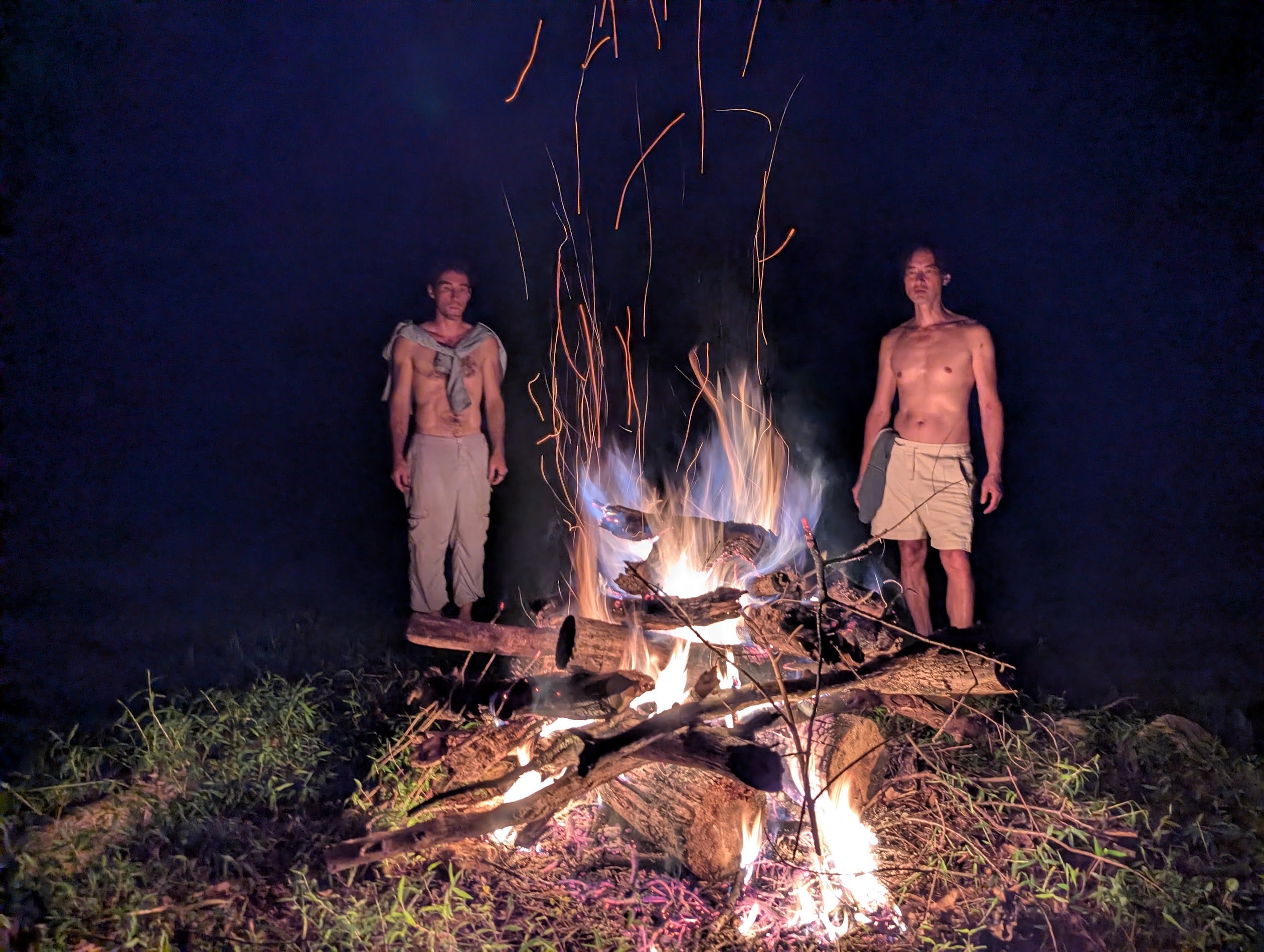
the fourth fire
The First Fire: La Creuse, France
The first time I encountered a sacred fire, I had to introduce myself to it.
This was in 2021, in a forest in La Creuse, in central France. I had taken a train from Paris to attend a peyote retreat led by a Mexican shaman. Soon after I arrived, before I knew the land or most of the people, one of the organizers brought me to the maloca. He asked me to offer the fire a small piece of wood and tell it my name.
They called this presenting oneself to the fire.
I felt self-conscious speaking to a fire, but I did it solemnly. I thought of myself as a visitor learning the customs of a new country. It reminded me of being taken to my grandfather’s grave as a child, of how my mother would ask me to say a few words to this man who died before I was born, and I’d do it mostly to humor her, but also with some sincere intention to connect to his soul, in case the laws of reality did allow for such a possibility.
The fire would burn for the entire ten-day retreat. Its keepers slept beside it and woke during the night to tend it. The shaman called it Grandfather Fire, working alongside Grandmother Peyote.
During the ceremonies, we sang and danced around the flames. Then there would be moments of stillness, when the Shaman and his team came around, brushed our bodies with feathers, then flicked the feathers toward the fire, as if casting whatever they had lifted from us into the fire.
The fire had a superpower: it could metabolize.
If someone vomited, cried, sweated, or spat, the fire keepers could push those substances into the flames. At a certain point in the night, after hours of singing and dancing, the fire keepers relaxed the boundary around the flames and invited us to come closer. We could speak to the fire and offer it something we no longer wanted to carry: stagnant energy, stored traumas, even addictions and other attachments. The power of the fire was clear: nothing withstood its metabolizing force; feed it anything and only ashes were left afterwards.
In the morning, a brand from the sacred fire lit a second fire that heated the stones for the sweat lodge, or temazcal. The temazcal was a low half-dome: a wooden frame buried under thick felt blankets. To enter, we each came down onto hands and knees, lowered our foreheads to the earth and said: “A todas mis relaciones,” dedicating any benefit of the session to all our relationships. Glowing hot stones were brought in on a pitchfork and laid in a hole in the center of the lodge, then the door flap was closed.
Inside the dark, cramped space, with our half-naked bodies pressed together, the heat became so oppressive our instinct was to escape. Instead, we sang at the top of our lungs. Singing together helped to take the mind off the heat, to remind each other in the pitch dark that we were there, and encouraged each of us to endure.
The Second Fire: Near Popayán, Colombia
Four years later, in December 2025, I encountered a different sacred fire at an eco-village near Popayán, Colombia. Almost twenty people were undertaking a vision quest on the mountain. I went as a supporter and was assigned to a quester named Andrea, who would remain alone for four days and nights without food or water.
Here I encountered similar elements as in France: the sacred fire in the heart of the maloca kept burning for the duration of the retreat; the sweat lodge which here was called inipi and which we entered daily; an all-night ceremony which preceded the procession up the mountain to install each quester in their designated spot; and another cactus brew– San Pedro in this case– which they called wachuma.
I joined a team sent into the forest to gather fallen wood for the fire. Someone showed me what to look for: the right lengths and thicknesses, pieces dry enough to catch. Back at the ceremonial site, I spent a long time sorting what we had collected into piles, from fine kindling and slender twigs to thicker wood that would burn longer.
The leader of the village was an older woman named Ana-Maria, who everyone called Abuela. She was an impressive figure. She wore a fedora like a Colombian rancher, and often had a lit cigar in her hand or mouth; tobacco was seen as the gateway plant for all other plant medicines, and its smoke was seen as a blessing, a purification.
This sacred fire was less accessible than the one in France. It was built inside a symbolic barrier made of stones and only the fire tenders could stand within those bounds. This fire was not used to metabolize our vomit or other purges. Instead, its superpower was transmission. As Andrea’s supporter, I was to eat and drink for her while she fasted for four days. In practice, this meant that every time I ate or drank, I thought of her and sent her my prayers. The fire was like a switchboard, taking the prayers of the supporters at basecamp and routing them to the corresponding questers on the mountain.
When Samson and I volunteered for a night shift watching the fire, we were told that if the fire were to go out, the vision quests would be interrupted and all questers would have to come down prematurely from the mountain. So the stakes were high, even if the shift was easy. We mostly sat in silence in the chilly night, staring into the flames and occasionally rearranging a log.
After the opening all-night ceremony, a group of women and girls came bearing breakfast from the kitchen. The wachuma had upset my stomach and I’d spent a good part of the night rubbing my belly and jumping up and down in an effort to burp and pass gas. I was also just exhausted from staying up all night in the cold. I’ll never forget the woman looking into my eyes and saying: “Buenos días!” She spoke with such joy that something in me woke up. The women offered us a sour funky beverage of fermented corn and– piled on fresh broad leaves– spiced ground meat and fresh corn pounded into a rough polenta.
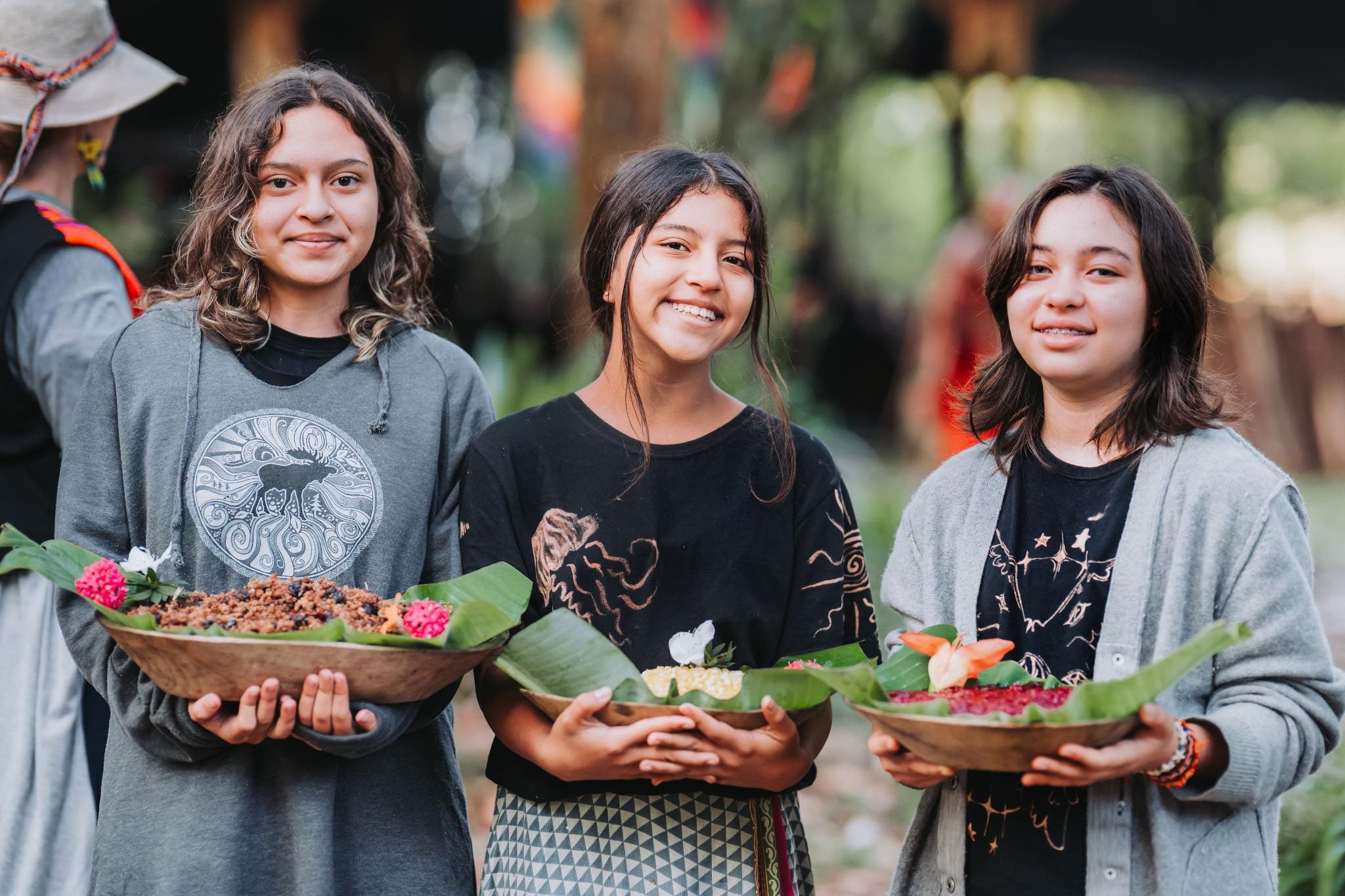
breakfast after the ceremony. photo credit Willa Kveta @nalayahealing
I would come to see that the medicine we encountered here was community.
Back in New York, a typical meal might consist of me buying takeout and eating directly from the carton while sitting in front of a Youtube video. Here, we knew the people cooking for us, and took our meals while conversing with friends, seated family-style at tables in the canteen. Three times a day, the kitchen produced food for everyone. Breakfast included scrambled eggs, arepas hot from the griddle, a large pot of hot cacao, and sliced fresh fruit like papaya and bananas. The kitchen was seen as sacred; flowers and burning incense stood on an altar in the corner.
After the trip, I was so inspired that I started to ask Samson when we could plan to return to the village. But Samson told me he was having doubts. He said that ultimately this was not his culture. Like myself, he was indeed moved by the care people showed each other here, but beyond that, he found the folklore of the fire, visions and animal spirits to be unrelatable, maybe too fantastical (these are my words). He did not speak Spanish, did not imagine learning it just to be able to participate in these types of ceremonies, and did not want to travel to Colombia every time he wanted access to this energy.
His comment stayed with me. I had had profound experiences in France and Colombia, but how would I integrate those experiences? How would I let these experiences alter my life in New York? I did not want to become a permanent spiritual tourist, going to distant places and paying for ceremonies.
This is when I formed a plan: I would ask my friend Sam to build us a sacred fire in New York.
The Third Fire: The Catskills
In April 2026, to celebrate my birthday, I rented a cabin in the Catskills, invited a few close friends to join me for the weekend, and asked my friend Sam to build us a sacred fire.
Sam’s apprenticeship in nature had begun in his childhood. His family lived on the outskirts of their town, adjoining the forest. When he wasn’t in school, he would be in the woods, playing and exploring, until it was time to go home for dinner. In his teens, he started to bring home the dinner, catching fish and small game and cooking it up for his family.
Once on a solo mushroom trip, he’d built a fire and entered into a special communion with it, the same kind of tie that shamanic fire-keepers have. Sam discovered that the fire’s language was a particular kind of vibration: laughter. He demonstrated this to me, making his diaphragm flutter so rapidly that it sounded like he was panting, producing sounds so high-pitched they were barely audible, like the ultrasonic squeak of a mouse. He said when he did that, the fire suddenly started to respond to his laughter, flaring up into a cone of blue flame, higher and higher, until it was tall as a tree. Sam puts it as: “After that experience, I felt I was authorized to speak to fire.”
After we arrived at the cabin and got settled in, Sam started combing through the surrounding woods, gathering firewood. He taught us how to assemble the wooden fire structure from the inside out. We all worked on it. At the center, we laid down a cube of twigs filled with kindling. Sam called this the first temple. Around it, we assembled a second temple, a box composed of longer, thicker sticks. Finally, we scaled up fractally, building a third cube of larger branches, some as thick as my arm.
When night fell, the wooden structure was waiting where we had left it. We only had to touch a lighter to the kindling in the smallest cube. The flame moved outward, catching one scale and then the next, until the whole structure became a blaze.
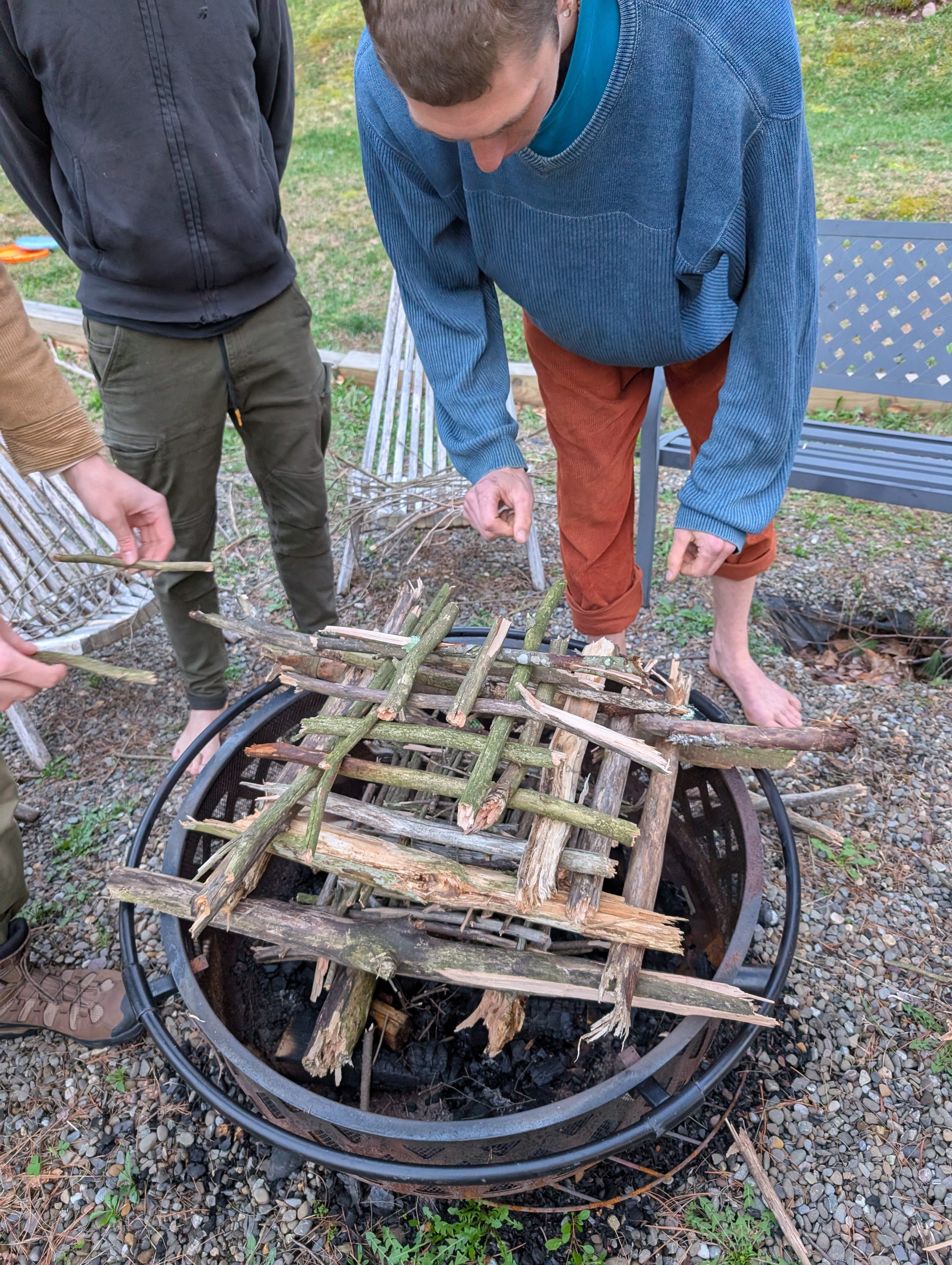
the wood pile
We sang and danced shirtless around the fire. A light drizzle cooled our skin. To keep warm, we turned our bodies toward the flames one side at a time, like rotisserie chickens.
This fire was beautiful, and we now had a template for how to build a fire and commune with it, but I felt we still needed practice. For several reasons, I didn’t feel we’d been able to achieve the same kind of ritual power I’d known in France and Colombia.
First, the cabin was a little too exposed and a little too precious. We could see the road and some neighboring houses from the deck, which made us a little self-conscious about making too much sound. Fancy white carpets and sofas seemed to say: don’t you dare spill anything here. Moreover, the container was a bit porous. A friend of a friend had heard we were in the area, and ended up dropping by to hang out in the hot tub. The mood was jocular, but I longed for the intensity I’d known in sweat lodges. And finally, we weren’t aligned in our intentions. While people had initially been receptive to the idea of taking a heart-open medicine together, when the night of the fire came, most of the group chose not to partake. I was disappointed, but hid it as best I could; I didn’t want anyone to feel pressured. The stars did not align this time.
That said, this weekend established a foundation. When another chance to build a sacred fire arrived months later, we did not begin from nothing. We already knew the form because we had prepared it together once before.
The Fourth Fire: The Hudson Valley
That next opportunity came in late August, 2026. Samson’s friend Harriet lent her country house, a geodesic dome on secluded land in the Hudson Valley. Tall trees separated it from neighboring properties. Downhill from the dome lay a pond that Samson and I had come to call the bog.
I had visited once before, at Samson’s invitation. On LSD, I walked barefoot through thick grass alive with seed pods, flowers, insects, pollen, and spores. I caressed the ground as if it were the skin of a lover and entered the pond as if entering a lover’s body. The land seemed to tell me that it could receive what I released and return it to circulation. What fire metabolized through heat, the living earth could metabolize through decay and digestion.
caressing the earth
After that experience, I was eager to return, this time with Alex and Sam, two of my most shamanic friends, and to show them this secret place.
On a Wednesday morning, we took the Hudson line from Grand Central. After getting off the train, we stopped at a grocery store run by Guatemalan immigrants next to the MTA station for some food. I tasted rice and beans from Alex’s white plastic takeout box. Then we hauled our luggage through the heat for the thirty-five-minute walk along the countryside road to the dome.
By the time we arrived, we were drenched in sweat. I undressed, walked outside and down the slope, and jumped naked into the pond. I hoped Alex and Sam would follow me. They did. Afterwards, the day was warm enough that the three of us remained naked while our bodies dried, walking through the grass and examining the plants. We took time to assemble the same three-box wooden structure we’d previously made in the Catskills.
Later, Sam, Alex, and I took a heart-opening medicine. We lay together, cuddled, and talked about our lives. I rested my head against bodies I loved and felt extraordinarily close to them. Being with them, I understood that healing did not have to come from a career shaman; it could be something the three of us generated together by trusting one another and caring for one another so completely. We were so absorbed in our trip that even after nightfall, we never made it back out to ignite the woodpile. The fire would have to wait for the next day.
The next morning, with rain expected, we protected the wood-pile structure with a tarp before setting out for our morning hike. We walked through a nature preserve nearby. We stopped several times: to climb a natural boulder problem we found; to stand in a wet bog of thick moss; to attempt to capture an elusive katydid that didn’t want to be held by human hands. It was still early when we came out of the nature preserve, so we decided to continue all the way into town. Samson was craving a soda. We ate lunch at a grocery store/diner, then on a whim, decided to check out the local hiking spot, called the Stone Church.
The spot turned out to be a natural cavern with a huge triangular opening. A brook passes through the rock and drops into the cave as a waterfall. Inside the cave, we sang. The rock amplified our voices against the pounding and hissing of the waterfall. The waterfall itself was deeper in the cave. To get to it, we’d have to wade through a pool of cold water. I stood at the water’s edge, hesitating, but before I knew it, Sam had disappeared. He’d found another way, climbing over a ledge so high up against the cave ceiling that he had to crouch and then slide forward on his belly. The stone was damp and slick. I felt the constant possibility of slipping and breaking a wrist or ankle, but I trusted Sam and kept following him.
When I got to the other side, Sam had already stripped naked and was scrambling towards the waterfall. He stood underneath it directly, letting the water hammer his body. I stripped down too and walked in, but could bring myself to stand only partially under the cascade; the cold and pressure were too intense.
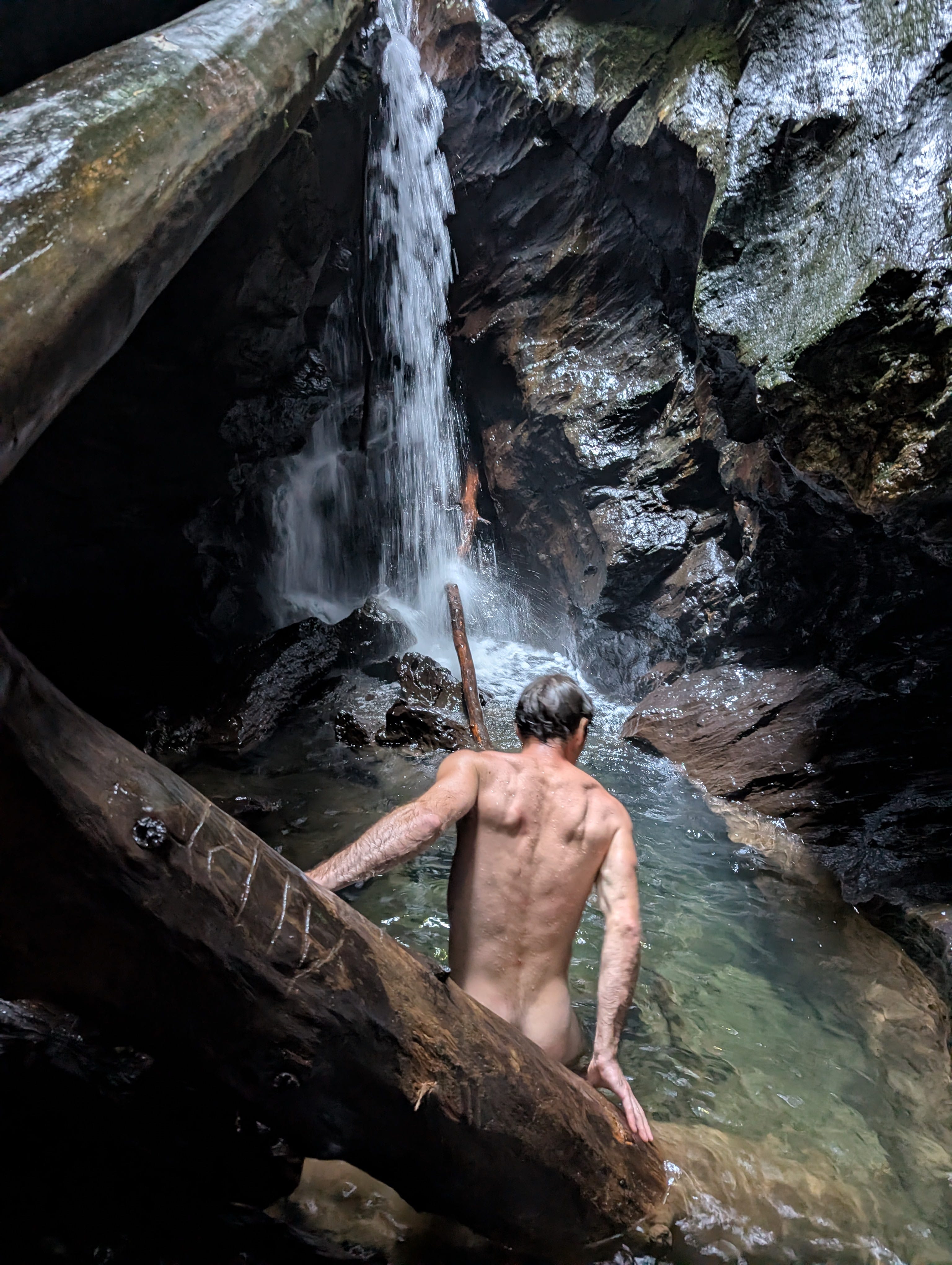
Sam at the waterfall
Though Alex hesitated at first, when he saw both of us getting in the water, he decided to join us. When he entered the cold water, he released a series of piercing, high-pitched whoops, almost like an animal yelping. I was startled by how loud and high the cries were. They were full of life. I loved the sound.
Leaving the cave, we found ourselves on one of the most beautiful hikes I had ever taken. Sam had told me that when he lived in Oregon, he took people into caves, lit fires, and led them through initiatory journeys. Here too he often moved first.
We scrambled up a steep slope and tried to circle back to the source of the waterfall, to the point where the stream entered the cave. There was one point when we had to jump from a ledge onto a narrow path below. Samson remained at the ledge, looking for some way to lower himself and gathering the nerve to descend. From below, Sam gently talked him through where to place his body and how to land.
We scrambled among rocks, moved in and out of shallow water while trying to keep our shoes dry, and finally climbed out of the gully. We found ourselves in a spot completely off the trails. Because nobody ever came here, the land was lush with unculled mushrooms: amanitas, chanterelles, and many others we could not identify. Sam was certain only about the black trumpets and collected them by the handful. I emptied the top pocket of my backpack and filled it with them for the walk back home.
We reached the dome before the rain began and avoided getting soaked. The rain arrived later in the day while the fire structure remained dry beneath its tarp. Sam cooked the black trumpets in butter with salt and pepper. That night, after the rain had stopped, we walked across the wet grass, pulled away the tarp, and touched a lighter to the kindling.
Then we sang and danced around the flames for hours.
We clapped, beat our chests, clicked our tongues, and made our bodies into percussion instruments. We improvised without needing to decide who would lead. A theme appeared; one person altered it; another found a harmony. Sam, usually so garrulous, fell quiet, observing the fire attentively, moving sticks towards the center, blowing on the brands through a diamond shape he made with his fingertips.
By the time we were ready to sleep, the thick outer branches were still burning. The fire stood in the middle of an open field, far from other structures, and the ground was wet from the rain. Sam said that sparks might fly but would not catch in the damp grass, so we left the fire burning. In the morning before leaving to catch our train, Sam returned to the smoldering remains and poured water over them.
At the end of our stay, Alex said, “This was like a retreat.” Nothing beyond the place and the fire had been planned. Instead we improvised with the elements that presented themselves: the pond, the cave, the waterfall, the mushrooms, the rain – weaving each into our flow.
Having been exposed to the pattern language of shamanic ceremonies and sacred fires, I found myself wanting to build my own fire, and now that that dream has come to fruition, I find myself wanting to organize my life so I can return to this fire again and again.
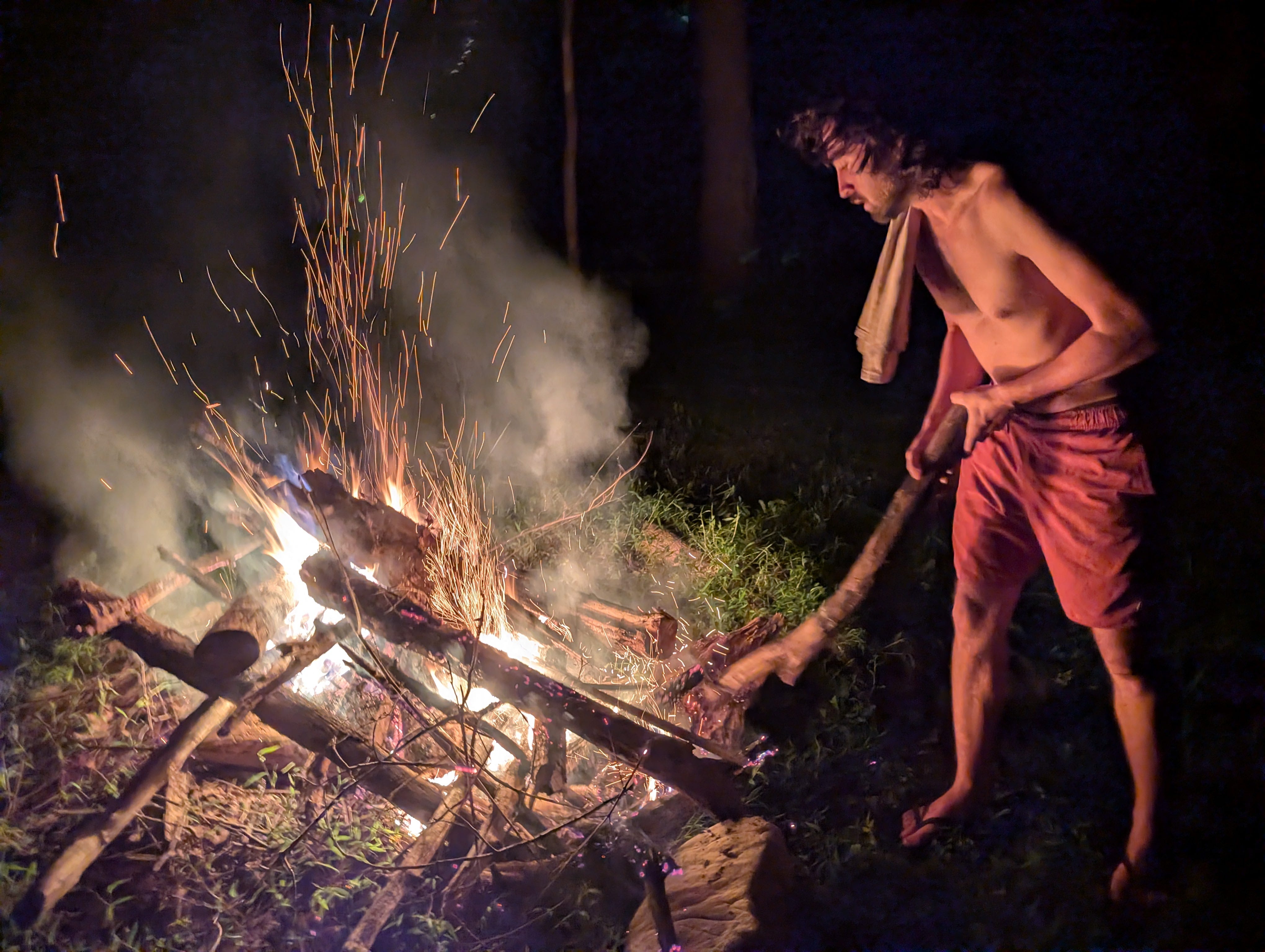
Alex at the fourth fire
I enjoyed the vivid details throughout this piece. Nice use of photos, too.
That was a beautiful piece, thank you for sharing.